

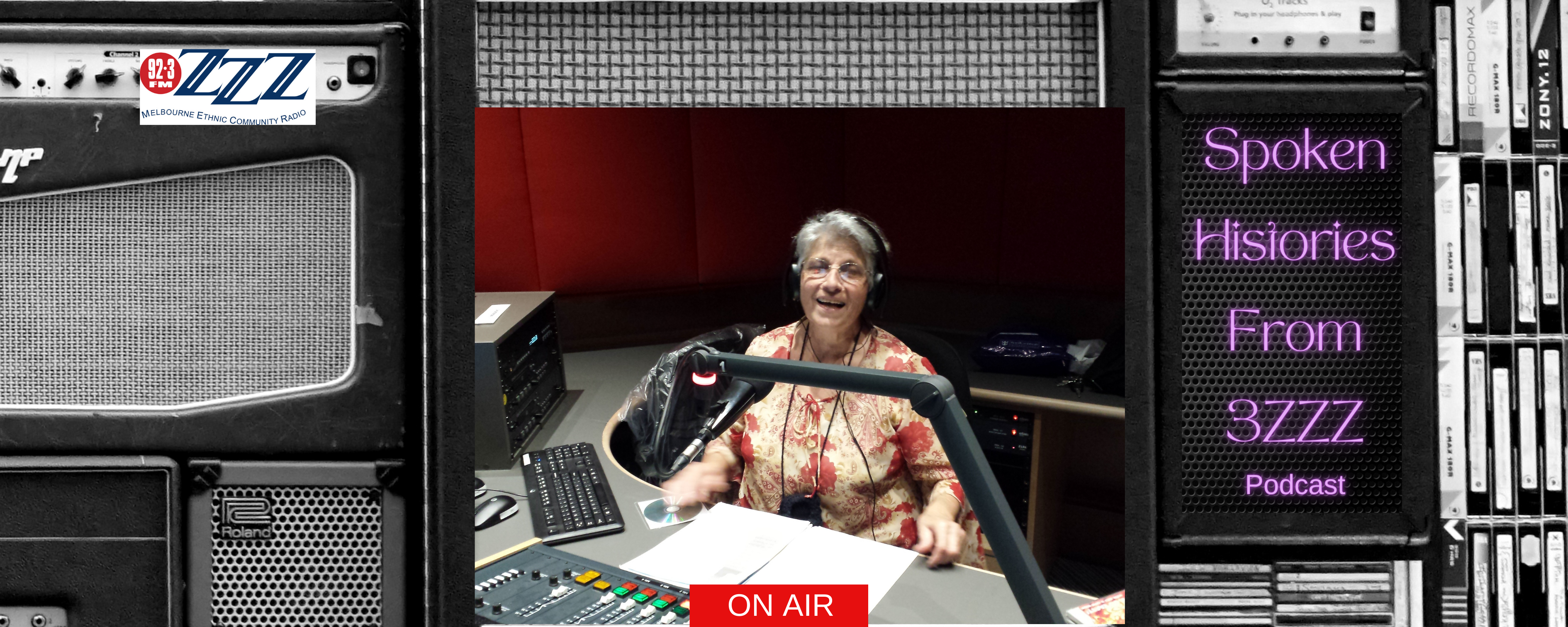
Radio for the Community! Spoken Histories From 3ZZZ
Today we will explore some areas in Angela Maisano’s career journey. She has been a voice for the Italian program on 3ZZZ for over 33 years.
Radio for the Community! Spoken Histories From 3ZZZ highlights the impact that 3ZZZ broadcasters have made to their communities, increasing diversity in community media, benefits of multiculturalism, sacrifices made by new migrants in Australia, and benefits of volunteering in community radio.
Note: this transcript is automatically generated and may contain errors.
Maram Ismail: Welcome to another episode of radio for the community Spoken Histories from 3ZZZ, a special podcast series celebrating some of the stories behind the voices of community radio in Melbourne. I’m your host, Mariam Ismail. Today we will explore some areas in Angelas Maisano’s career journey. She has been a voice for the Italian program on 3ZZZ for over 33 years.
Angela Maisano: I would say never give up. Why? Why would you give up something so good? Because I think if we can help other people to feel the joy that we experience, why not? A few people have told me, stop doing this, stop doing that. I said, well, sit in the chair and wait for that to come.
Maram Ismail: Angela’s journey with 3ZZZ started when her community made a call for representation on the radio. A simple yet significant act of collecting signatures led to the birth of the Italian program.
Angela Maisano: I remember that. I knew very well two gentlemen that they brought us the news to say, as we were in a meeting somewhere, that they have the opportunity to have an hour or 2 or 3 or whatever on the radio. But they said that they ask us if we ask people Italian people, because I’m Italian, to say if people want that. So we start to ask people to sign paper and we collect more than 100 signatures. So we took them that, but nothing done with me. I just helped the people do the signature. And so they start this program.
Maram Ismail: Beyond the radio. Angela’s dedication to her Italian heritage shone through her work in education. As a teacher’s aide, she filled a crucial gap, helping non-English speaking parents navigate the digital world and empowering them to connect with their children’s education.
Angela Maisano: I work in a school and I was doing a teacher aide in the Italian language, but then after I worked quite a few years in a teacher aide, I used to organize festival. Another thing I used to sense, well, let’s call suffering, because I can’t think of a better word of the parents. They could not speak English when they came to meetings. They thought they could speak every language because I could speak Italian. They used to call me to the office every Greek parents. But I don’t speak Greek, she says, but you seem to understand better than us. And of course, because they would say, I would say to them slowly, are you here for what do you want? Talk to the teachers, or do you want to see your son? What is it? So they would understand even if they got one word of that, it says, oh, my son’s sick. I want to tell teachers in hospital. Oh, that’s what you want to say. So they would call me in the office like that. So a parent came to me in Italian parent one day, gone to the office, asked for Mrs. Maisano. The office says this lady is nearly on in tears. Can you see what a problem she’s got? So I got to the office and I knew the parent, but not closely. I said, yes, what’s your problem? Your son is okay. Oh, nothing to do with your son, you know. And she got very angry and she said words that should I should not have heard. Really angry. She said he left this computer on and I don’t know what to do. I can’t I said, don’t worry, computer is not going to break. I said, if your son left her on, what do you do? Just leave it. When he comes home, you tell him that you don’t like him to leave the computer on. If that’s because then she said, what about the electricity? I said, you’re right, the electricity used not as much as you use it, I said, but still is on. I said, when your son comes home, you just tell him mom doesn’t understand the computer and I don’t want to touch, but I want you when you finish to stop. So another day, another lady came and talked to me about anything else, something a bit more related. I went to the principal and I said, look, I think I sense some problems with the parents, that the kids now, they have computers, they don’t know what to do. Parents, they never seen one. And they’re worried about what? About if I do a computer class for parents and he said, how are you going to do? I said, well, I don’t really know, but I’ll think about it. I said, but I would like them to introduce to say, you open like this, you turn off like this, at least something that they’re going to say, I don’t want to touch, otherwise I’ll break. And then they worry. So he gave me the permission to do that. So I went to the library and I tried to look for a book. I had to use computers. So I started to photocopy pages and then chop, paste start like this. I made myself a booklet and I made copies of. And then I invite the parents to come to school. I had nearly 20 parents coming for the first time, and the parents learned to not be scared of touching the computer. And we were doing that every single year for the parents of grade six to come and learn the computer.
Maram Ismail: The microphone at three became Angela’s instrument, playing a symphony of Italian eloquence to her listeners. She shared her wisdom not just on external beauty, but the grace that resides within, a message that resonated with her audience and marked the beginning of her broadcasting legacy.
Angela Maisano: One was a pastor of our church where I go and his friend. They were two of them, the two gentlemen. They were Italian, but they didn’t speak Italian fluently, like. Me because I went to school in Italy, I was Italian, they were born here and they most spoke the dialect of the parent, and one was Sicilian and one was Calabrese. And they have got two different dialects. So when they spoke, even they tried to speak Italian, but it wasn’t a pure Italian. And so they told me this problem. So I said, but do you speak just like that or you prepare something? They said, no, we write it down what we want to say, and then we say, I said, well, you know what I can do. You prepare your thing, I’ll correct in proper Italian and give it back to you. And that was my first job. A couple of days before they go to the radio, they would give me the whatever they want to talk about. I would fix for them in the proper Italian, type it up and give to them back so they could read it until probably they were had been by six seven months in the radio and one day I don’t know how was I happened to go to where they had the office, what they were doing something work at this church, and I wanted to go and see what they were doing for it’s like that. I mixed myself in everything I said to my husband, I think I want to go there. I said, go, I want to see what they’re doing. I went there and they said, It’s Tuesday today. We’re going to the radio. Are you going to the okay, I’ll go. No, you come with us. Come with you at the radio. No, no no no I said no, no. It goes insisted. Just go in the room. Prepare something. Even five minutes. I want you to talk on the radio, I said. I can’t think of anything. I went in there and I said, what do I say? And now I remember what it is because I never forgot. I said, I’ll speak on the beauty of a woman that is not only the exterior, but it’s also the interior. How we receive when someone talks to us and we enter. So I went and I prepared five, six, seven minutes that the woman has got a lot of beauty. But it’s not an outside beauty, it’s inside beauty. So I went to the radio with them and he said to me, nice, you know your time, give me the microphone. And I did. When we finished and we closed, I said, you know, I thought was so difficult to have a radio program. I said, it’s so easy. It’s easy. How would you like to come? We give you one hour, I said, but I work, I’ve got a family, so choose the time. I go, what’s the hour? And he told me Tuesday we come and the Thursday, Saturday I said, well, if it was at night. Because then during the day I’ve got a lot of work to do. He said, yeah, yeah, we can change with anyone. I said, it’s easy between us. We change time as long as we tell the listener from now on, that’s the time. And I said, yeah, I’ll try. One Saturday night I went and he said to me, I’ll call an was a friend of mine. She was about 20 years younger than me. She said she’s good in talking, and we were friends and she lives in the same street I live. She said, you come with. Then I said, okay. So we went and we both enjoyed her. And I said, well, what do you think? And I said, I would love her, but we have to take, you know, our work too. And um, I said, all right. And so we took an hour on Saturday night. Then time comes and I start to cut down the hours at my work because my husband said, look, you don’t want to leave work. Cut the time. You’ve got this, this, this now too many things. And I said, I’ll ask the principal. The principal said, yeah, you can cut your time. We’ve got no problem for that. I decided, say, yes, I’ll do it. So I took an hour. Then somebody else came and he said, do you want to change the time from Saturday to this other day? I said, look, if I can change to work, I will change. So I changed and I was doing on Tuesday and the Thursday morning they gave up and I said, well, I’ll see if I can change my time at work. I asked, they said, yeah, you can change. You’re doing community work. Yeah. So they changed my hours without cutting the hours. Just give me a different time. And I worked. As I said, I worked till I was 75.
Maram Ismail: The Italian program under Angela’s guidance became a reflection of Italy itself. Each segment was a mosaic piece depicting Italy’s regional diversity and historic cities. Listeners journeyed through Italy, discovering its hidden gems and traditional celebrations.
Angela Maisano: I start by looking at our listeners. In fact, I done this to ask the listeners where they come from because Italy, it’s only a small country. It’s not that big. But every region, even in every region, they will be five, six, seven dialects. So it is quite. An interesting thing. So I would start to look at the dialect and talk about like how we initiate what they did what and the things that they like to do. One region from another, they’re very, very different. Everyone from Italy, they come from different country. So the very first thing that start to learn to talk about their region, where they come from, what they produce, what they do. So other people we know. So if I come from Lucania, they don’t know that in Lucania we’ve got a lot of lambs where we call it that’s it’s a great place for that. Also, it’s a very ancient. My city. It’s prehistoric. It’s one of the oldest city in the whole world. So we start to look at places of Italy that no one knew to tell them. And so we start to enjoy learning around country through the radio. And the people would ring and say, there was nice. I never knew that that city had a castle and never knew this, and I never knew that. And so when the people used to tell me, I never knew this, and I go, ah, so I can go on this other line, then who knows? And they would give me more idea what to tell them for the next time and next time.
Maram Ismail: 3ZZZ Women’s World program became another canvas for Angela, where she painted pictures of domestic life with broad strokes of practicality and spirituality. From recipes to advice, Angela’s segments warmly embrace the women in her community, offering a place for learning, sharing and growth.
Angela Maisano: Most of the things what woman loves to do. So we used to have recipes, new recipes, simple things like how to cook and be nice and not, you know, uh, you know, when you read the recipe, five gram of this, three grams of that, I would make easier. And it says, you know, you’ve got a garden pick up this, this, put this, then put this other thing. The recipe is done. So we used to do recipe. We used to do where can you find things. Other places where they could go to receive some other whatever it was needed. Like whatever it goes, uh, like even to say to some people, you know, I heard that that community, like in Brunswick, they’re teaching computer free for parents or for people they live. We would tell them, because we find in the newspaper advertise that they’re doing and would tell, and we call the ABC, but 15 minutes to say where they can go when the school holidays, we say, you know, the kids, you can take them there is here free of charge so you don’t have to spend money, uh, all this so whatever goes in the community, that. And then towards the end we put a spiritual program. The women’s were not dead for quite a long time until, yes, the things got bad with my daughter. And, uh, because where the time also I had to spend another extra hour in between to start. Then the other one was like almost going the whole day out, and, uh, and I had to find even some people to help me because then you get tired. You did already one hour, and then you do another one because it’s on Thursday. And, um, but then I met, um, orietta. She’s wonderful. And we worked together a lot with her and on and off. Even when I stopped, she would say to me, this festivity is coming. You want to do this? You know, she knew that I like to do it, so I would do it.
Maram Ismail: The role of radio in maintaining the vibrancy of the Italian community in Melbourne cannot be overstated. Angela’s stories have been widely appreciated, keeping the Italian language alive in homes far from Italy.
Angela Maisano: We have half an hour, definitely on everything. What’s happening in the world on Tuesday? Perhaps people, they stay home like recipes. They’re more announcement. So we call it ABC, which is more or less announcement and it goes a good 15 minutes. We’re telling the people all the most interesting things. Like for this Thursday, I just came across again that something happened in our friendship that someone died with breast cancer and someone said, why didn’t she have a mammogram? I said, now they don’t push you anymore to do the mammogram like they used to do in my time. I used to have a letter all the time, and we used to advise people the same because I say it’s good for me if good for others, but they don’t do it. And this poor girl, 20 years younger than me, she died recently. She was a good help at the radio too, and she was so good to the last minute. And then, I mean, the first day she was with me, she was fine. And then the following Thursday she rings me, telling me she’s in hospital because some other friend of hers told I don’t like the. On your face. Why don’t you go and see a doctor? And she was a smart girl. Very smart. Her name was Angela, like me. And she went to the hospital and they put her in straight away. And then the following week, she was dead. The cancer had gone all over the chest and all over the other part. So we have these segments. We have tissues. We tell them what’s going on, where they can buy things good and all. In this. We’ve got also a Christian segment because whatever has happened to be really good in Christianity. Now the Italian people, they’re very Christians in the sense of the word that they all we can’t say that Italy is not Christian, even though they might not go to church. But if you say, where are you? I’m a Christian, so they love to listen. So we put a segment of the Bible, 15 minutes. I love to do that because I enjoy that because I did Bible studies. Teresa, ask other people to do that. There’s a gentleman that rings from quite far away and he said, I could do that if you want me. So we analyzed what he said. We enjoyed it. And he rings every Tuesday. He rings every Tuesday, and they give him 15 minutes and he does that. There is two girls that do a fateful every Thursday once two Tuesday each. On Thursday. I do all the time myself because the other people that were helping me at the moment, one is not available and the other one died. She was always with me and now I have to find somebody else.
Maram Ismail: Angela has had many memorable moments during her time with 3ZZZ radio. One of her favorites was participating in the Unity in Diversity broadcast, a ten hour national event celebrating Australia’s cultural diversity in February 2016. During the broadcast, Angela shared her thoughts and insights on the experiences and challenges faced by the Italian community.
Angela Maisano: Yeah, I remember doing, but the mostly easy things that I would do, I would talk about my culture, what we were doing and what the people that came to Australia are missing. I remember saying, now this came to my head. I was saying that some people, they don’t speak English, so the children go to school. Yes, they go and get the report. The teachers talks that they might go, yeah, yeah, yeah, yeah. But when they go home they don’t know nothing because they didn’t understand. Because I remember that when I start to work in a school, I just felt for them. There was one Greek parent one night we had that I start to have not only the computer in the school, also a parent nights where I would get the parents together and let them tell us about your child. What do you think you need extra that we can do it? And this Greek parent got up and took her movement by touching his trousers, shaking his trousers, standing up from his legs. Not that he took her off and he said, if I only would know that my child wasn’t doing well at school like now, because I start to get interpreted in the school that I found that thanks to George Zangalis that he helped me because one day I came to visit the school and I said to him, these parents can’t speak the language, you know, doesn’t matter what the teacher tells them. And he said to me, you know, that the government can give you interpreter free of charge. I said, I didn’t know. So I start to put that in motion in my school. And when we were Parent-Teacher night, I would have seven eight translators there for most of the language that I could get the language. And I remember one person said, there are many parents you’ve got on that. I said, one and he said, and you want an interpreter for one night? First I was about to say something, and then all of a sudden I said, excuse me, every parent is one. I said, just because I’ve got them five together, but they all work for their child. I said, so this unfortunate parent that is the only one that speaks this language. Why shouldn’t I get him an interpreter? He should be punished because he’s got on his child. Everyone else got one child at school, maybe two. And they said, yeah, you’re right.
Maram Ismail: Angela made significant contributions to the Italian community through three trips, and her work crossed the borders of Australia. She provided mentorship to numerous young students from Italy who, like many others, were touched by her dedication and warmth.
Angela Maisano: Actually, there was one stage where in Italy I don’t know who did that, but there were advertised in the schools so someone that wanted to visit Australia. They would have paid. I was asked if I would receive a student and I said, what do I do for this student? Like I have to feed him. I mean, no, no, no, just at the radio. He has to stay with you three months and learn whatever you’re doing with that. And I said, well, that’s easy for me. And for quite a few years, this was probably started on maybe on the 10th year that I was, if I correctly remember this in my head. And, and I had a person that stayed with me, one that actually Valentina was a name. She was so impressed of the program that I was doing that. Um, when we did a particular anniversary, I wrote, I think, the 20th anniversary I wrote to this young people that had stayed with me. I said, be nice if you say something and send it to me. And they did. And I remember that she said something really nice. She said, she said, I met this lady full of energy, this and that, that she asked this program that gave me all these ideas to do things and that I got that. And then I would give them a, um, in fact, I’ve got some photos of them. I would make a certificate that they had worked with me. And I got to take with you, because in Italy, when you apply for something, this is something you’ve been all the way from Italy to Australia to do this course. This could be valuable for you. And yeah, I’ve got a few, few of those. I had the boys and girls different times now. Most of people, they come to Australia, they can’t get in Australia unless they speak already English. And I don’t know how important we will still be. But being a multicultural radio in another way, I think we still important because I’m thinking that even a person that comes now and already knows English, they want their kids to not forget their language that they speak, and so they enjoying for them to listen. Listen to this program because that’s our language. In order that the kids can keep their heritage they don’t want, no one wants to lose their heritage. I can see now with my great grandchildren that I write little things in Italian to say in Italian. Just a few words like mommy, I love you, daddy, I love you in Italian. Say this in Italian to mommy, say this in Italian to daddy because we don’t want to lose who we are. And I think that the multicultural station still will have quite more few years to go, even though they obligated to speak English when they arrive in Australia.
Maram Ismail: In the golden twilight of a career that many might consider complete, Angela stands firm on the front lines of community service, her voice a familiar comfort to many, echoes through the airwaves, undimmed by the passage of time. Despite gentle nudges towards retirement, Angela’s response is unwavering commitment.
Angela Maisano: Why would I stop? Just last week, this lady I ran over, I said in the program, she called me. At the end. She says, don’t you dare leave. Because you don’t know what you’re doing to me. I love this program so much. That’s the best hour in my day. She said don’t. Please. Because if I could describe what you’re doing, I don’t have words to say. But it’s so lovely when I know that I open the radio and I hear your voice saying this and this. So why deprive people of that? I believe to keep involved in things, not sitting in a chair. I’ve got a bit of a problem with my blood pressure that goes down. A few people have told me, stop doing this, stop doing that. And I said, what? Sit in the chair and wait. Death to come. I said, I’d rather to die while I’m doing something.
Maram Ismail: Her resilience is an inspiration, a reminder that passion knows no age and purpose does not wane with time. Angela’s presence on the radio is more than a programme. It’s a lifeline that continues to resonate with the Italian community and beyond.
Angela Maisano: I would say that we are very thankful that we’ve got this particular mean, that we can reach out so many people in so many ways. They are sick people at home, and I’ve visited quite a few of those that they were faithful people. They listen to the radio. In fact, now that I’m thinking, one lady that used to be one of the first listeners died. You’re probably not going to believe this. They asked me to do a funeral. Now you say, what did you do? Of course. They took care of everything. I had to speak at the funeral. And someone in the time that I spoke, I spoke at just what this lady was telling me, that how much she loved the programme, what the programme was doing for her day in, day out. And that’s what I conveyed. And even the person that the leader agreed with that because he said, I met this lady and she was always speaking about this program, and I met you. And then one person when we finished came to me and says, when I die, would you like to do my funeral? And I said, I didn’t do because they paid me. I said she had become my friend. It’s nice. I enjoy doing the program because I wouldn’t say for myself because that would be silly, because you do things for yourself. But the best things is when you know you’re helping someone. And when someone says, as I said a couple of weeks ago, that this lady said, don’t you dare leave because you don’t know what you’re doing to me in that hour. That’s the best thing can happen to me when I turn that hour. There you on. So you say, why would I leave? Even though my husband tells me. Don’t you think it’s time to retire?
Maram Ismail: Angela’s advice to those interested in community radio is imbued with her passion and experience to persist, share joyfully and never underestimate the impact one can have on others. Her continued presence on radio is an evidence to her belief in the power of connection and community.
Angela Maisano: I would encourage a lot of people to do that. I don’t know when I’m going to stop to do that because it’s lovely to meet people from different nationalities, and I don’t think we should fade away very quickly. I don’t think so. I think people still. Want to let other people know who we are and what we’re doing. Like, I know some other people that they not Italian. And they say to me among our groups when we meet says, I listen to your program. I like your Italian. You know, I learn this or that, but they’re not Italian. And they says, I tune in just because I like the sound of Italian. And I learn some and they say some words that they learned or something. I think that community radio is wonderful because we’re reaching people in the language that they can speak, and we have to understand that people of our generation, they didn’t have chance even to go to school. And that’s sad. I was lucky, but there is a lot of people that couldn’t even go to school because the parents could not afford, or they had to go and work the field with them because, um, I great most of the people that migrate now, wealthy people come to Australia, but before was the people they’re looking a place where they could work every day and get paid every day and not work in Italy when they could find one hour to go here or two hours to go there. No community assistance, nothing at that time. So we don’t want this to close. Not because of that anymore, because that is not needed, but for people to keep their language, their history.
Maram Ismail: Thank you for listening to this episode of radio for the Community Spoken histories from 3ZZZ.
Radio for the Community! Spoken Histories From 3ZZZ is proudly supported by the Community Broadcasting Foundation.