

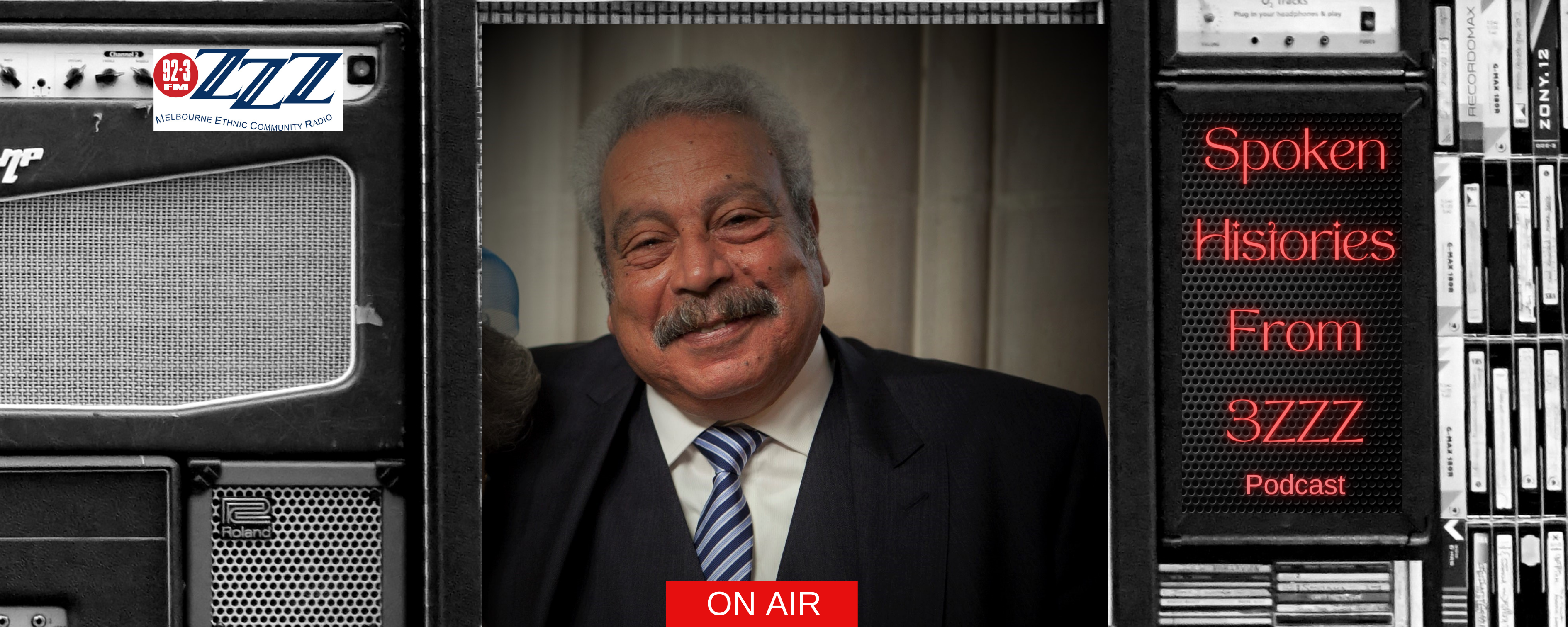
Radio for the Community! Spoken Histories From 3ZZZ
Today we’re getting to know Dr Raouf Shafik Eid, a retired medical practitioner and a significant voice in the Egyptian program at 3ZZZ, Melbourne’s vibrant multicultural community radio. He is one of the founding members and the Egyptian program convener.
Radio for the Community! Spoken Histories From 3ZZZ highlights the impact that 3ZZZ broadcasters have made to their communities, increasing diversity in community media, benefits of multiculturalism, sacrifices made by new migrants in Australia, and benefits of volunteering in community radio.
Note: this transcript is automatically generated and may contain errors.
Maram Ismail: Welcome to radio for the Community Spoken Histories from 3ZZZ, a podcast that explores the lives of the people who helped shape community radio in Melbourne. I’m your host, Mariam Ismail. Today we’re getting to know Raouf Shafik Eid, a retired medical practitioner and a significant voice in the Egyptian program at 3ZZZ, Melbourne’s vibrant multicultural community radio. He is one of the founding members and the Egyptian program convener.
Dr Raouf Shafik Eid: We are human beings and we have our ups and downs. Sometimes, you know you have to broadcast when you are very down and you tried, you know, not to reflect your mental state during the program, but it will reflect sometimes on your performance.
Maram Ismail: Rauf’s journey to Australia in 1983 was marked by challenges and new beginnings. Despite the hurdles he faced in recognizing his medical qualifications, he says that his proficiency and resilience have helped him navigate the complexities of a new life in Australia.
Dr Raouf Shafik Eid: I am a medical practitioner, I came here. We face a lot of problem recognizing the know my profession. It was a long journey. Apparently the English was not an obstacle for me because I studied in English. My English was good. Even when they do they know the accessory to see the level of it, and they say they know we can’t put you in any category because you are opposed to the requirement we need to start life in in Australia. Anyway, it was a long journey. Until now.
Maram Ismail: The decision to leave Egypt was a challenging one. Like many migrants, Raouf was driven by the desire for a better future for his family and the longing for a community connection in a new land.
Dr Raouf Shafik Eid: My motivation? It was a bit difficult for me in Egypt. Everyone, I think, who left his country and came here. He has his own story and has the know his own motivation. Mine was a bad experience in Egypt. The main thing is, you know, which affect me is the future of my kids. I have a son and a daughter and one day I was thinking deeply, you know, what the future will carry for them here. According to my experience in Egypt, most of my brothers were here. I have four brothers and a sister who came before me, not much relative in Egypt. So that would put me, you know, to apply for immigration. So mainly for me, my motivation was future of my kids.
Maram Ismail: Rauf’s venture into community radio was inspired by a desire to give back to his community and reconnect with his roots. His sisters involvement in broadcasting served as a stepping stone for him to join three triple Z.
Dr Raouf Shafik Eid: At that time. You know, we were young. We wanted to serve the community in any way, especially when you are, you know, in a different country and you want to gather, you know, with the community as a general, you joined, you know, the Egyptian community. And apparently my sister was approached to broadcast. So anyway, it was, you know, a bit of community service and supported, you know, who is there from our family to join three triple Z. So once she said, you know, there is opening a station in the near future and we collecting members for. So anyway, I joined it and my wife and everybody was start to encourage people to apply for the membership. And we gathered the, you know, the amount needed and we started.
Maram Ismail: From its inception, the Egyptian Programme on Three Jewels aimed to revive and share Egyptian culture with the diaspora in Melbourne. However, the programme’s early days were marked by challenges in sourcing news and music from their homeland.
Dr Raouf Shafik Eid: That was how to revive the culture in Egypt, the most difficult part because everyone is far away. There was no internet, there was no, you know, social media at that time, no mobile. So the most important thing, do you know how they know what’s going on in Egypt? And that was very difficult at that time because you rely on very primitive methods regarding, you know, collecting the news, doing interview with some of the celebrities in Egypt or the politically activated. So that was difficult because you rely on nothing, you rely on shortwave. You have to get the no special radio. It was very expensive at that time. But you rely on the shortwave to collect the new news about Egypt. Maybe it wasn’t, you know, up to date, but at least within the, you know, the framework of 1 or 2 days. The other thing is the music material. It wasn’t easy because you rely at that time. It was the reel to reel that’s very big. And the cassette was in the beginning of the cassette. So that sort of thing, you know, you start the program with plus, you know, searching the magazine books, translate or get some items from Arabic books or whatever, interview with people and we start from there.
Maram Ismail: The Egyptian program has evolved over the years, adapting to new technologies and expanding its content. The program has become a key platform for sharing news, interviewing influential figures and covering social events, thereby playing a crucial role in keeping the Egyptian community in Melbourne connected with their heritage.
Dr Raouf Shafik Eid: We were young at that time. We were motivated. We rely on, uh, interviews from overseas and you can imagine one day very near, we remember with my sister who we interviewed during the journey of the Egyptian program, and we were amazed. They know how many people participated, how important these people. And then it came, apparently with your own experience, you get advanced. So you started, you know, from very primitive things to more semi-professional. That’s why the Egyptian programs continued until now. We used to cover some of the social events in the community, like, you know, there is dancing group coming or some function for the other societies. We try to cover it pre-recording materials and introduce different knowledge to the community, immigration, how to deal with the Egyptian authorities now and then. So that sort of thing you concentrate on what will, uh, will benefit the society as a general. But the most important thing is, you know, which we concentrated on was the Egyptian news, because there is no other material except three triple Z and the Egyptian program. I know that there was some special service, but they get you the Middle East news. Not specifically to the Egyptian.
Announcement: The following program is Egyptian. Al-bernameg Al-khadim Al-bernameg al-Masri.
Dr Raouf Shafik Eid: So our program was purely 90% news, which concerned Egypt and the Egyptian. We try to participate in the general knowledge which can affect the community. We announced all the varieties of activities from other organization, whether they are members or not. Interview. We have a lot of people which can pass knowledge to the community regarding immigration, health, education, travel, all these sorts of things. You know, once there is a major event or something which can affect the community, we try to interview some people to give all the knowledge they need to do it. We don’t have much Egyptian artists here. Most of them are professional. Most of them seek information regarding immigration. That was at some time very important and some regarding drug abuse. So we have a professional which can discuss this sort of very important things, especially for people with young age. And how you can educate them to find the early signs of drug abuse or anything like that.
Maram Ismail: Rauf and his team have achieved significant milestones, including interviewing prominent figures from Egypt. The program has served as a news source and has been instrumental in supporting humanitarian community initiatives.
Dr Raouf Shafik Eid: We interviewed Boutros-Ghali, which is the at that time, he was about to receive his position as the General Secretary of the United Nations. We interviewed Ahmed Zewail. He came here before his Nobel Prize. We interviewed some of the most influential people in Egypt. Now they passed away like Farag Foda, Rafat Saeed and many, many of them, Pope Shenouda many times. So that was the milestone was, you remember in the 90s, there was the earthquake and joined with the CBS and all the local communities. We joined them, you know, to raise money for victims of the earthquake in Egypt. We are not politically motivated or religion motivated. We are in the middle. We keep distance from each parties. We don’t incline, you know, to indulge religion or political issues in the program. So we speak generally to the whole community, and apparently they know we are satisfied. This reflected from membership and the radius on how many organizations involved with us, any anything. We are open to all the communities as long as it doesn’t divide the community. Yes, there is some issue which is hot in Egypt, but as I say, we manage it with reasonable approach and try to get the facts and not the myth. I think most of of our program is sort of achievement most of the time. We introduced, you know, very significant materials which can affect the community and satisfy their needs. We receive few awards from three triple Z, as I said, you know, we try to serve the community more than to achieve anything else.
Maram Ismail: The program began with three hours of broadcasting and has seen many broadcasters join and leave over the years. Despite this, Raouf and his colleagues, a mix of seasoned and newer broadcasters, have continued their commitment to the community.
Dr Raouf Shafik Eid: You’re not always beloved 100%. Some people, they love you, some people they don’t like, and you can’t satisfy everyone. So you do. You know, you do what you are convinced that it is in the benefit of the community, the broadcasters. Now they start with us from long time. Some joined and some left, some passed away. But all of them, they have the same experience, maybe more than me. I am more administrative than broadcasters. They have involved more in broadcasting. I was involved more in administration. So we have seven, seven broadcasters, three females, four males. We have now six members of the committee. We used to be seven. Last month one passed away. So it was a long journey with them. All of them participated with us. Maybe some. Some joined us in the middle. But anyway, we continued.
Maram Ismail: Balancing a demanding medical career with a passion for broadcasting is no small feat. Rohff speaks about his experience.
Dr Raouf Shafik Eid: It wasn’t easy because most of the time I can manage. It wasn’t. You know, I am not 24 hours broadcaster or community member, so it was limited, you know, three hours a week. It wasn’t a big problem because there is some other broadcasters. So it means that you approach the program twice or three times a month, which is not a big deal. Preparation. You can use your leisure time to prepare for the signature. Going to introduce, but it wasn’t a difficult to match between them. May be the logistic way was difficult parking, especially when we start in the old trade centres in the basement, parking was very difficult. That was the problem. And twice they know they towed away my car. And you come down and I park the car here where it is. So as I say, you know, logistic it is difficult.
Maram Ismail: Ralph sees opportunities for community radio in an increasingly digital world. He acknowledges that changing landscape of broadcasting and the need to engage younger generations in preserving cultural heritage through media, really.
Dr Raouf Shafik Eid: You know, as you see, I am old. So the concept of digital, I think it is too much for us, for me personally and I don’t know, you know, how to approach maybe you know, you can give more time. You can give more varieties of program especially it is a radio. It is not it is not a TV which can attract you by image and by pictures. You have to advance yourself through the years. The listening. What is it is important for the interest of everybody. It is very difficult now because as I say, we start from the wireless and now we are digital going to the digital area. And I know that the digital area, you can introduce many channels without any effort. You know when they come here, they don’t have much information. Maybe they now it is it is easier for them to go through the internet. You can produce your own material at your own time with your own equipment, and you can broadcast it. That’s one of the advantages of digital.
Maram Ismail: Ralph advises new migrants in Australia to integrate into the community while maintaining their cultural identity.
Dr Raouf Shafik Eid: Number one, forget about your own experience in your back country and start from the beginning with a new vision to your future. If you stuck to the old way, which you will deal with your country, I think they know I’m talking about the bad things. All right, good things. You can keep it because that will promote, you know, your own personality. But any problems you face in your own country, leave it at their door. Start from the beginning and start to know what is the community you are going to because you may create a lot of problem. If you don’t know the community or the society you are going to live in. So concentrate on how to get in harmony with the community, how to mend or to participate. I don’t say that you abolish your personality, but how to add in the good way your personality to the new society. You’re coming in. So you have to be broad minded. Don’t judge everything with your own heart, but with your own thinking. A little bit of heart. So I think they know that’s the that’s the way I face the many problem, because my thinking in the old, it was attached to the way I raised up.
Dr Raouf Shafik Eid: And it doesn’t fit in the Australian community. If you live in Australia or in any other country, try to understand this society very carefully and how to mind and affect them in a good way. I think that’s my experience. My advice. Love each other, understand the person in front of you, and put yourself in their shoes before you start to criticise the other person, because your circumstances is completely different than the person next to you. So a better of understanding may be some. Sometimes we don’t satisfy our listeners to the T, but we are human beings and we have our ups and downs. Sometimes, you know you have to broadcast when you are very down and you tried, you know, not to reflect your mental state during the program, but it will reflect sometimes on your performance. As I said, you know, for every person, try to understand. That’s the golden rule. Try to understand the the person next to you.
Maram Ismail: Rauf expresses his deep gratitude to the listeners of the Egyptian program on three triple Z. He believes their support proves the program’s impact and its substantial role in uniting Melbourne’s Egyptian community.
Dr Raouf Shafik Eid: Really, we are very thankful, you know, for our listeners, their support is great and you feel it when the time comes for the radiothon, for the membership, when we ask for support, they are very generous. They are very supportive. They didn’t put us down anytime many years, you know, more than 15 years now. We collected past our target. They are very generous to support the until when God knows because we start to with people their youth now as a broadcasters and the community and everything. You are aging. No new blood to be honest, no new blood. So we don’t know after us what will happen.
Maram Ismail: Thank you for joining me in this episode. You have been listening to radio for the Community Spoken Histories from three triple Z.
Radio for the Community! Spoken Histories From 3ZZZ is proudly supported by the Community Broadcasting Foundation.